
Foraged Ferments
And our summer of wild webinars

I recently found myself attending a bluegrass festival in Chicken, Alaska (I just couldn’t resist an event called Chickenstock). On a morning walk to the river, I came across and woman and her young son gently caressing the trees lining the path. Next thing I knew, they popped something in their mouths. That’s when I needed to know more.
They were harvesting young white spruce tips for homemade spruce syrup. As a teacher, she does this every year with her students. She was thrilled to find a forager’s bounty in Chicken, as the trees in her hometown of Fairbanks were no longer boasting their tender tips (I apologize for those living below the arctic circle, you will have to wait until next spring to try this out).
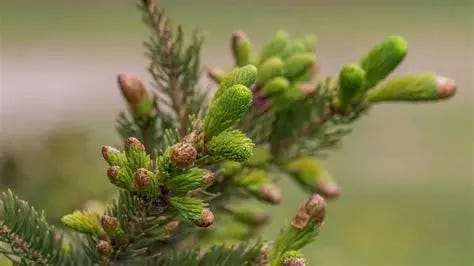
As my new trail friend and I admired the light green growth, she began telling me about her foraging approach, which many of us know as sustainable harvesting. Sustainable harvesting is built upon core principles that prioritize the health and longevity of natural systems1, principles such as gathering from only mature, healthy trees, not over-foraging, and harvesting with respect and intention for the plant and land providing the gift. Outdoor Apothecary has an in-depth guide to foraging and using spruce tips.
I promptly returned to my campsite to retrieve my trusty mason jar. After asking permission, I sampled a few tips from different trees. They varied widely. Some were lemony and bright, others piney and astringent. Some I thanked for their offerings and moved along. One tree I found reminded me of fruity pebbles.
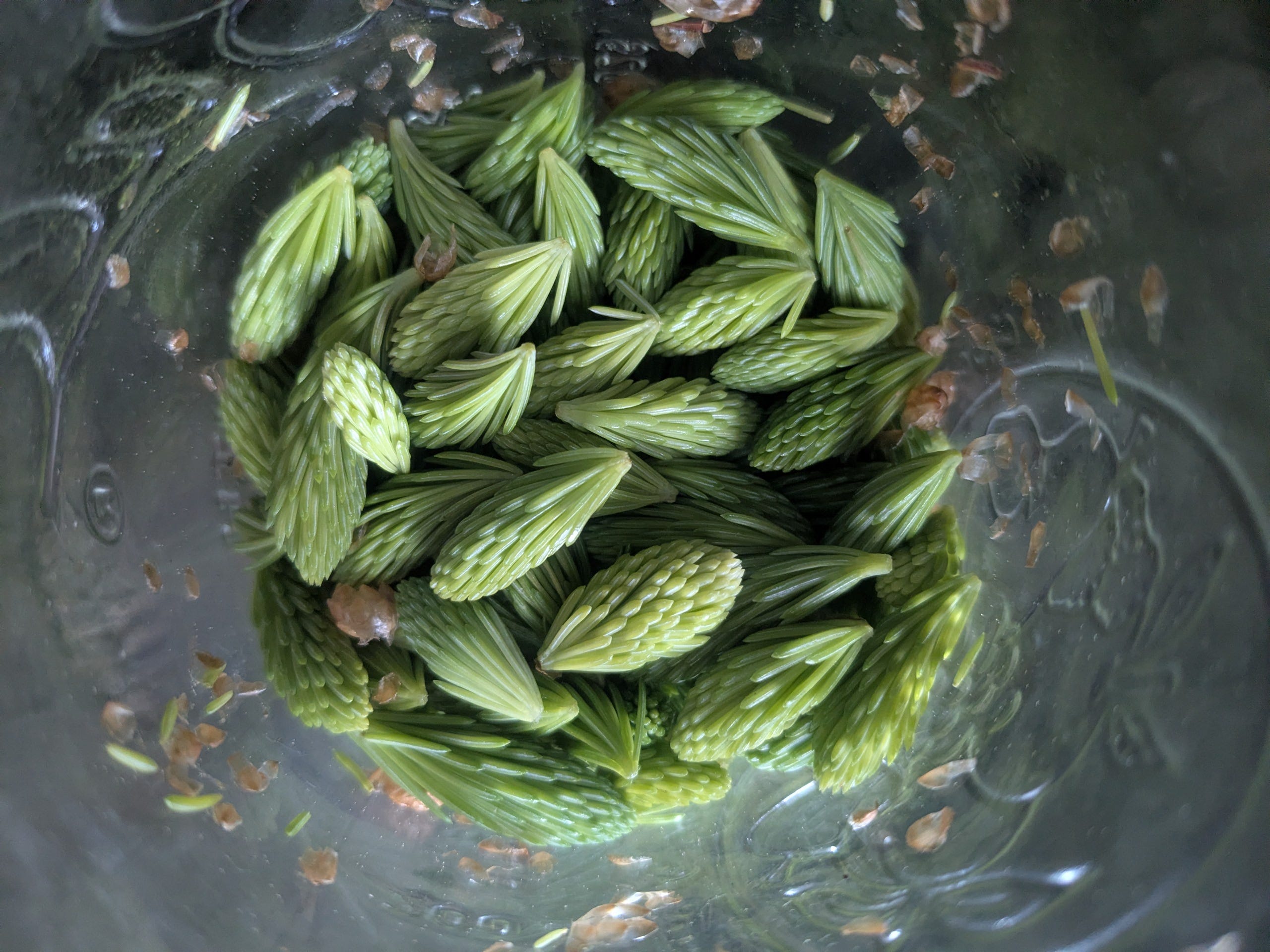
The syrup making process is simple: add brown sugar and allow the tips to macerate for a few months in the sun. Immediately I suspected that fermentation was at the root of this transformation, similar to fermenting in honey. There’s no way introducing plant material teeming with microbes to a jar of sugar does not induce fermentation. I suppose time with tell with my little experiment. Fermentation or not, coniferous tips provide a plethora of nutrients, including loads of vitamin C, antioxidants, polyphenols, magnesium, calcium, the list goes on. They can be used to make jellies, salts, teas, skin products and more.
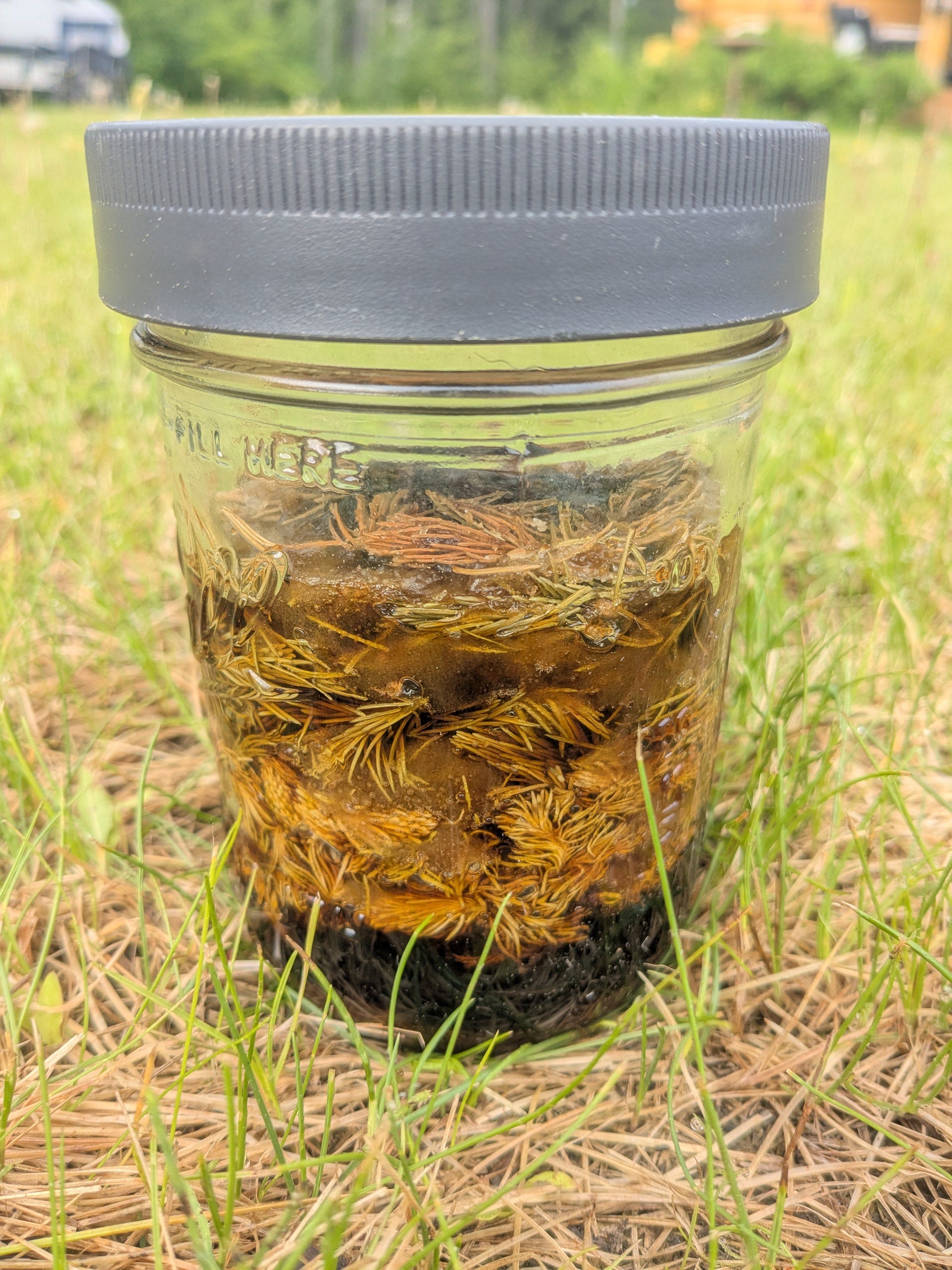
Do you have experience making this delicious treat? Or any other recipes using foraged ingredients? One of my go to’s is wild soda made with juniper berries, honey and apples. You can learn more about how to capture wild yeast in Kirsten’s Flower Power: Foraging for Wild Yeast course. I would love to hear about your experiences foraging and fermenting. See you on the trail!
Spruce Tip Syrup - Recipe Courtesy of Alan Bergo of Forager Chef
Ingredients
2.5 cups (8oz) Spruce tips
2 cups (16 oz) Brown or organic sugar
Instructions
Combine the spruce tips and sugar and pack the mixture into a quart jar.
Alternately, pulse the spruce tips and sugar in a food processor which will help ward off mold and speed up the fermentation.
Leave the jar out, putting it in a place where the sun will warm it each day. I’ve left them outside without issues. The warmth of the sun will help prevent mold.
You’ll notice the volume of ingredients decrease as the spruce tips release their liquid. If you have more spruce tips and sugar, feel free to add mores in the same ratios-this will lower the amount of air in the jar and defend against mold.
Keep the jar like this for 1 month, or for an old school version, bury it in the ground and dig it up the next spring. Stir the jars occasionally, pressing the tips down to keep them under the syrup with a clean spoon.
To make the syrup
After the initial maceration (aging with sugar) pour and scrape the spruce-sugar slush into a pot. Add two tablespoons of water for each quart jar of tips and sugar to help prevent crystallization.
Bring the mixture to a simmer just long enough to dissolve the sugar, strain, then bottle and store. Discard the spent tips, and thank them for their service.
If for some reason, your syrup is a bit thick after cooling (over-reducing can stiffen or crystalize in the fridge) warm it back up and carefully adjust the consistency by adding a touch of water.
Storing the finished syrup
Store the finished syrup in the fridge. To preserve it long term (it’s totally safe as it’s basically all sugar) pour it boiling hot into a jar nearly to the brim, turn upside down and allow to seal, or process in a water bath in mason jars. If held at room temp after opening mold may form on the top, but it can always be re-boiled and refrigerated. This is a very stable product and will last like maple syrup in the fridge-near indefinitely.
Summertime Fun-time
The summer solstice is tomorrow! Please join us in celebrating this season with our upcoming events. We are incredibly excited about the people and content we have lined up for our students.
June 28, 2026 at 10 am Pacific Time our guest is Anthony DELFAU of Fermenterie KEALA in France.
Anthony will be sharing his fantastic presentation, Beyond One Starter: Why Strain Diversity in Tempeh Making Matters. This presentation dives into the history and strains behind the fermentation of tempeh, cheese and koji.
July 16, 2026 8:30 am Pacific Time: Lessons From Outer Space: How to grow spirulina at home with Aga Pokrywka.
Learn how to grow your own spirulina through the insights of an astronaut from an analog space mission. This process, known as phototrophic cultivation of microbes, supports wellness, daily routines, and a mindful connection across species.
August 4, 2026 at 10 am Pacific Time: Making Fermentation Crocks with potter Jody Beck.
See and learn about all the steps that go into making a handmade fermentation crock from raw clay to finished product.
Online
July 18 - 26, 2026 Desi Cultures brings together fermentation practices rooted in the Indian subcontinent and connected global conversations. From everyday ferments to emerging research, this is a space to share, question, and learn—across disciplines and geographies.
Thank you for this. Nigel Palmer has a garden amendment technique where you ferment garden ingredients (eg, comfrey, borage, carrot tops, etc, any high nutrient garden material) in sugar, and then dilute (about 1:500) and use as a fertiliser in the veggie garden. They really actively ferment! It is amazing to watch. I have often wondered whether the technique would produce things for use in the kitchen. You've convinced me that I should start tasting my garden amendment ferments.